Showing posts with label Artists. Show all posts

Saturday, September 27, 2008

Paul Newman Dies


Paul Newman has died after battling cancer. He was 83. The Houston Chronicle reports:
Paul Newman, a major figure in American cinema who created indelible characters for more than half a century, died Friday at his home near Westport, Conn., after a lengthy battle with cancer, publicist Jeff Sanderson said. He was 83.


An Ailing Newman in MayIn this May 10, 2008 file photo, actor Paul Newman watches from the pit area during practice for the Indianapolis 500. (AP Photo)

Newman's first movie, The Silver Chalice (1954), was an embarrassment, but he was lauded for his portrayal of the boxer Rocky Graziano in Somebody Up There Likes Me two years later.

He chose roles wisely. Among his highly regarded films are Cat on a Hot Tin Roof and The Long, Hot Summer, both of which were released in 1958. He made some of his biggest hits in the 1970s, including The Sting, in which he starred with Robert Redford, and The Towering Inferno.

As a young actor, the charismatic Newman never exhibited the soul-baring intensity of Brando or Dean — to whom he was sometimes compared — nor the unguarded vulnerability of Montgomery Cliff.

"He seems to me an uneasy, self-regarding personality, as if handsomeness had left him guilty," the critic David Thomson once wrote of Newman. "As a result, he was more mannered than Brando when young, while his smirking good humor always seemed more appropriate to glossy advertisements than to good movies."

The camera, however, loved Newman and so did movie audiences. His appeal clearly went beyond looks.

Writing of his role as a cad in Hud in 1964, the New Yorker's Pauline Kael wrote, "They could cast him as a mean man and know that the audience would never believe in his meanness."

Continuing, Kael said Newman was the type of actor who projected "such a traditional heroic frankness and sweetness that the audience dotes on them, seeks to protect them from harm or pain."

Newman received nine Oscar acting nominations and won once — in 1987 for his performance as Fast Eddie Felson in The Color of Money. The film was Martin Scorsese's sequel to The Hustler, the 1961 drama for which Newman received his second Oscar nomination and one of several roles for which he shall be forever remembered.

Additionally, Rachel, Rachel, a film Newman directed in 1968, was nominated for best picture. He also received two honorary Oscars, once in 1986 for his body of work and again in 1994 for his humanitarian efforts.

The Color of Money was widely seen as inferior to The Hustler, but it demonstrated that Newman seemingly had grown more relaxed in a face and body that, while still strikingly attractive, no longer looked as if they had been sculpted by Michelangelo.

Arguably, Newman did his best work in middle age and beyond, in films such as Money, The Road to Perdition (2002) and, especially, The Verdict (1982), Sidney Lumet's drama (from a David Mamet script) about an alcoholic lawyer past his prime who must try the case of his life.


with Joanne Woodward in Long Hot Summer

Newser says:
Newman got his start in theater and on television during the 1950s, and went on to become one of the world's most enduring and popular film stars, as well as a favorite of his peers. He was nominated for Oscars 10 times, winning one regular award and two honorary ones. He is survived by his wife, actress Joanne Woodward.


I always enjoyed Paul Newman on the Big Screen. His political opinions were typical Hollywood, and not worth remembering. Actors do age and pass on, but it seems the greatest are never really replaced. Thus we lose some fantastic talents every year, it seems, while no one appears able to pick up thier mantle.

We'll miss Mr. Newman.


[...]

Butch Cassidy: Then you jump first.

Sundance Kid: No, I said.

Butch Cassidy: What's the matter with you?

Sundance Kid: I can't swim.

Butch Cassidy: Are you crazy? The fall will probably kill you.


Newman's finest fight scene:


"Rules? In a knife fight? No rules!" - Ted Cassidy

Click here for the final scene from Butch Cassidy & the Sundance Kid.

Kim Priestap notes Mr. Newman's passing.

Thursday, September 04, 2008

Sarah Barracuda!


Chris Muir gave us this great comic for the day. Do you remember "Heart"?:


Click here for a bigger image. Feel free to donate to keep Day By Day going!

Also ... Weasel had this to say about Sarah Palin and the Leftist MSM:
Okay, here’s what I don’t get. The moment I heard Sarah Palin was the nominee last week, I did what every self-respecting card-carrying noun-hyphen-adverb does in 2008 — I ran right to Google and plugged her in. I read up on her, old and new. Pro and con. Then I did a Google Images search and gave her the hairy eyeball. I wanted to hear her speak, so I watched footage of a debate performance in the Alaska gubenatorial race. I spent maybe an hour at it, and then I pretty much made up my mind.

[...]

So how the hell could our mainstream media be caught so flat-footed by her performance? We know they read D-KOS, because they helped spread that stupid lying trash about Trig Palin. So, like, we know they have computers with internet. How could they POSSIBLY not read a little news while they’re at it? (You know what this means: other than the echo chamber of the op/ed pages, they don’t consume their own product. No wonder it’s such shite).

[...]
You have to read this! Warning: Weasel writes with naughty words, too. But read it! He nails the MSM to their own booger-encrusted wall!

Note: Don't miss The Anchoress' round up, nor her live-blogging of Palin's speech. The Anchoress, as always, is spot on! Donate to her, too! She can use the help to keep her blog going.

Also, Hawaii Governor Linda Lingle spoke at the Convention. She didn't make a great speech, but it was worth listening to. And she did have this enjoyable line:
I find it especially amusing that the other party says Governor Palin lacks experience when their own candidates for president and vice president ... have NO executive experience ... ZERO! Neither Senator Obama nor Senator Biden has ever managed a multi-billion-dollar budget, or been a chief executive of any city ... or state, of any size ... or of anything for that matter.

Which gave me the inspiration to make this banner:

zerObama

And this, too:

nOpe!

Thursday, April 10, 2008

Memories: Wicked Game


Funny how you hear a song and it seems like it was just yesterday you first heard it. In some cases I know I am kinda astonished to realize just how many years have fled since I first heard a tune. To me the songs of the Beatles remain fresh as the day they first reverberated from the radio. The same is true of a lot of bands and singers. And that includes singers I did not hear of until they had been active in the music scene for quite some time.

The first time I can recall hearing "Wicked Game" by Chris Isaak was barely over ten years ago. At the time I was working in the Seminole Casino, over in Tampa, and the sound system played some station all night long while we cleaned the place. "Wicked Game" was one of the tunes that I heard and remembered. But to me, hearing it then was it's first incarnation. What a surprise to learn that it had been released as far back as 1989. Folks, that's nearly twenty years ago!

My ex used to have a bit of a thing for Chris Isaak. But the name meant nothing to me. Though I had heard "Wicked Game" I had no idea who the artist was. So when she would ask me to buy her a Chris Isaak album - she lived in Wyoming, or Texas, at the time - I would find one and buy it for her. I never put the name and the song together.

A few months ago I was watching some sort of concert on TV. It may have been a PBS offering, but I don't recall. Anyway the artist was Chris Isaak and Silvertone. And he performed "Wicked Game". I think, aside from finally putting two-and-two together, what I really enjoyed most about the performance - and I do like this song immensely - was that Isaak didn't add lots of flourishes and crap to the performance.

I know some people like the concert versions of their favorite bands. They get a kick out of the free-form some bands take to the music they perform live as opposed to the studio version. But I prefer the studio versions of most music. After all, that's the way the band or artist originally wanted to present the song to the public. I could care less about a drum solo added or a guitar riff that lasts five minutes. Give me what was first recorded. That's what I paid for in the first place.

As for Chris Isaak, he's considered in some circles a Rock musician, in others as a Country musician. Me, I think he's managed an interesting mixture of the two. Isaak has his own unique musical sound as well as a compelling voice.

Here is one version of "Wicked Game" for you to enjoy. This is a music video with the studio version of the song. Click here for YouTube's unembeddable video: the version I saw on TV. Live with Silvertone. I think you'll enjoy both. And if you don't recognize the title of the song or the name Chris Isaak, I'm betting you'll recognize what you are hearing.

"Wicked Game" may be 20-years-old, but I think it's as fresh as ever.


"Wicked Game"
by Chris Isaak (1989)

The world was on fire and no one could save me but you.
It's strange what desire will make foolish people do.
I never dreamed that I'd meet somebody like you.
And I never dreamed that I'd lose somebody like you.


No, I don't want to fall in love (This world is only gonna break your heart)
With you (This world is only gonna break your heart)


What a wicked game to play, to make me feel this way.
What a wicked thing to do, to let me dream of you.
What a wicked thing to say, you never felt this way.
What a wicked thing to do, to make me dream of you and,


I want to fall in love (This world is only gonna break your heart)
No, I want to fall in love (This world is only gonna break your heart)
With you.


The world was on fire and no one could save me but you.
It's strange what desire will make foolish people do.
I never dreamed that I'd love somebody like you.
And I never dreamed that I'd lose somebody like you,


No, I want to fall in love (This world is only gonna break your heart)
With you (This world is only gonna break your heart)
No, I... (This world is only gonna break your heart)
(This world is only gonna break your heart)


Nobody loves no one.


Chris Isaak - Ladies' Hearthrob

Okay, he's a good-looking guy. I get why my ex had a 'thing' for him.

Sunday, March 02, 2008

Mars: A Video Journey


I’ve been thinking about making this video for a while now. I collected images of Mars, then searched for a piece of music that would work with them. Along the way I got to thinking of Edgar Rice Burroughs’s Martian Tales which began with “John Carter of Mars”. So I added a few images of Frank Frazetta’s and one, I think, by Boris Vallejo. And the music search continued.

Suffice it to say that Mars from Holst’s “The Planets” didn’t quite work for me. And my stash of Classical didn’t seem to fit, either. Where to turn? Nowhere. I put it on hold and went back to writing and blogging and surfing the Net. But the project did not sleep easily. Yesterday at work a tune filtered into my head and I was trying to remember the words to it and the proper complete tune. When I got home I had long figured out the artist whose song I was letting wind through my head all day.

The Moody Blues’ “You Can Never Go Home”. I enjoy the Moody Blues, especially their first eight albums. You always know you’re listening to the Moody Blues when their music is playing. It’s unique. I like the way it moves from ballad to driving orchestral Rock and back again. So I played the song and realized I had something that would compliment the images pretty well.

Below is the result. It’s simply called “Mars”.

I hope you enjoy it as much as I do. Let me know what you think, and feel free to comment on it. Enjoy!


"You Can Never Go Home"
by The Moody Blues

I don't know what I'm searching for
I never have opened the door,
Tomorrow might find me at last,
Turning my back on the past,
But, time will tell, of stars that fell,
A million years ago.
Memories can never take you back,
home, sweet home.
You can never go home anymore.

All my life I never really knew me till today,
Now I know why, I'm just another step along the way,

I lie awake for hours, I'm just waiting for the sun.
When the journey we are making has begun,
Don't deny the feeling that is stealing through your heart,
Every happy ending needs to have a start.

All my life I never really knew me till today,
Now I know why, I'm just another step along the way,

Weep no more for treasures you've been searching for in vain.
'Cos the truth is gently falling with the rain,
High above the forest lie the pastures of the sun,
Where the two that learned the secret are now one.

I don't know what I'm searching for
I never have opened the door,
Tomorrow might find me at last,
Turning my back on the past,
But, time will tell, of stars that fell,
A million years ago.
Memories can never take you back, home, sweet home.
You can never go home anymore.


Note: You may notice this is hosted at Metacafe rather than one of the usual video sharing places. When I began uploading this video in the early afternoon I ran into a plethora of ils. Suffice it to say that when I went to bed at 9:15 last night - with a 3AM wake up for work! - the video was sitting quietly at the AOL video site where it played like a 45rpm record on a 33 1/3 rpm record player. No clue why. I gave up and was ready to just quit on it. Before I left for work this morning I went to Wiki to find a listing of video sharing sites. Two of them poped up and I have this posted at LiveLeak and Metacafe. Both allow blog embeding, which is what I need, and both are fairly straight=forward in their instructions.

Blogger took over two hours, uploaded seven times, and kept erasing the post, the embed, and asking me which file I wanted to upload. *grrrr!* YouTube had some odd trouble "processing" the video. Strange since my Silent Night video uploaded and processed without a hitch. And MySpace can kiss my 'sit-upon'. What a time waster that was!

So this Mars video has been more of a journey than I ever expected. But at last it's here, done, playable. I hope you think it's worth it.

Thursday, December 20, 2007

Silent Night

Here is a little video I put together with some images I searched for and a Christmas Hymn as performed by Libera - Libera is the Boys Choir from Great Britain which I blogged about not long ago. It’s also known as Angel Voices. And I think you’ll agree with that title when you hear them sing “Silent Night”.


Here are the lyrics if you’ve forgotten them:
Silent Night
(Gruber/Mohr)

Silent night, Holy night
All is calm, all is bright
Round yon Virgin Mother and Child
Holy Infant so tender and mild
Sleep in Heavenly peace

Silent night, Holy night
Shepherds quake at the sight
Glories stream from Heaven afar
Heavenly hosts sing Hallelujah
Christ, the Savior is born

Silent night, Holy night
Son of God, love’s pure light
Radiant beams from thy Holy face
With the dawn of redeeming grace
Jesus, Lord, at thy birth


If you have trouble with the video try clicking this link to get to the My Space page with my 3 videos on it. I hope you enjoy 'em!

Wednesday, December 05, 2007

Libera: Angel Voices


Libera

From Wiki:
"Libera is the third 'public' name for the boys' section of an Anglican parish church choir from South London. The boys are between the ages of 7 and 16. Some boys stay longer to help coach the younger children."

Angel VoicesThe second "public" name they used was "Angel Voices", and perhaps that is how the general public knows them best. It certainly reflects the sound this choir/boy band produces. And the boys in it don't actually see themselves as members of a choir, but as members of a different sort of band. Heaven knows they're popular, and they get gigs!

How did I come to "discover" them? I was merely lounging on my bed, reading a copy of Paul Johnson's "A History of the American People" (a good read, by the way), and semi-watching the television. I flipped the channel, hit the local PBS station, and rather than find the umpteenth airing of "Celtic Women" or Suze Ormon spending hours talking about money, I saw white robes and heard young voices. And since it 'tis the season, I surmised I would be seeing a church choir performing Christmas Hymns and Carols.

Nope. Whatever I was hearing it wasn't Christmas songs, but sounded a bit like Latin, and then between the last two songs a few of the boys spoke. They addressed the audience - which was in the Netherlands - and you could tell they had done this before. Very professional, these young boys, smiling, clear of voice and word, and giving off just a touch of impish good humor. Perhaps you can see it in the images I've posted.

Well, after all, these are boys, not little Angels, so if they are merely impish then they are probably well-behaved *wink*. And the fact is they were good at this concert. Very, very good indeed!

When the program ended I rolled off the bed and wandered into my living room to hit the computer and find out about this group. First I checked the TV lisitings page on the browser, which lets me know what shows are airing in my locale, found the channel and the time, with the title of the group: Libera, and I was off and surfing.

Naturally, along with a Google search, I checked YouTube where I found quite a few videos of the group, some studio videos and some from concerts. I also found the website of Libera where a number of videos are available for viewing. Of course these videos are not postable, so I headed back to YouTube to find a good one to share with you.

This video is called "Sanctus" and is arranged, I suppose, by the group's director and songwriter Robert Prizeman. This is a Latin Hymn - Catholics may recognize the words, though this Protestant only recognized that it was Latin - and the lyrics are below.


Sanctus
Sanctus, Sanctus
Benedictus qui venit in Domine
Sanctus Dominus Deus Sabbaoth,
Pleni sunt coeli et terra Gloria
Benedictus in nomine
Qui venit in nomine


Sanctus is described in Wiki thus:
Sanctus is the Latin word for holy, and is the name of an important hymn of Christian liturgy.

In Western Christianity, the Sanctus is sung (or said) as the last portion of the Preface of the Eucharistic Prayer, the prayer of consecration of the bread and wine. In this setting, the Sanctus immediately follows the preface of the eucharistic prayer. The preface, which alters according to the season, usually concludes with words describing the praise of the worshippers joining with the praise of the angels.
[...]
The text is adapted from Isaiah 6:3, which describes the prophet Isaiah's vision of the throne of God surrounded by six-winged, ministering seraphim. A similar representation may be found in Revelation 4:8. In Jewish liturgy, the aforementioned verse from Isaiah is uttered by the congregation during Kedusha, a prayer said during the cantor's repetition of the Amidah (18 Benedictions).

Although the Sanctus is traditionally set to plainchant, many composers have set it to more complex music. It constitutes a mandatory part of any mass setting. In the eucharistic prayer, the Sanctus is usually followed immediately by the Benedictus.

Amazing, don't you think? No crashing drums and cymbals, no whine of electric guitars, no mumbled lyrics or screaming vocals. Just a hymn to GOD. Sung with beauty, smiles, and a practiced perfection, by boys in white robes - as the one lad said during the concert, "They're good for hiding things, too." - performing for an appreciative audience.
The boys out of the robesIn describing the group’s style, Wiki had this to say:
The musical and visual style of Libera has changed, along with the name, at various points during its history. The distinctive white robes now worn arrived soon after the change of name to Angel Voices. Previously, standard choir robes or normal clothes were worn by the choir. This variety of style has continued, but the white robes have been worn more and more. The music has always been distinctive, even when based on traditional choral music; originally, the music was traditional choral music such as Amazing Grace interspersed with modern music like Orinoco Flow or You Are the New Day. Since becoming Libera, however, the style has become more distinct. Although the choir mostly sings new compositions by Robert Prizeman, who still directs the choir, the new compositions contain elements of Gregorian chant and classical such as Debussy, Beethoven and Pachelbel. The lyrics are either new, as most of the album Free is, or are translations from the Latin text to Christian services, a good example of this being the song Vespera from Luminosa. We are the Lost uses the poems In Flanders Fields by John McCrae and For the Fallen by Laurence Binyon.
Libera added drums and synthesizer and, despite the meanings of some of the songs, is very upbeat, whereas Luminosa is calmer and quieter with a much more reflective mood over all.

Album coverThey have recorded CDs, and perhaps have some DVDs of their performances, too, which you can buy if you're so inclined. Had I the shekels to spare I would buy one or more of the CDs. The music really is lovely. Quiet, lyrical, melodious, soothing to the soul.If you’d like to see more, click on the YouTube link above which is the search results page I found, or you can head to Crackle.com for another video of the group. This one is “Stay With Me”. Well worth the visit.

Libera: Angel Voices. A very nice change of pace for the ears and the soul. I recommend them, my friends. Have a great week!

In concert

Wednesday, October 03, 2007

Some Boogie Woogie & Some Sinatra


Growing up in the Sixties, I remember that my folks played a lot of music. Dad worked for RCA then and had some wonderful stereo equipment. They played their old 78s and then the LPs of the music they had grown up with. Rock 'N Roll was not on the playlist. But what was on the playlist was some wonderful music. It isn't like we kids were unaware of the Rock 'N Roll scene, but we didn't hear it at home. Grown-ups run things, don'cha know? And I have to confess I missed out on not one thing.

So my Sibs and I listened to Sinatra and Glenn Miller, Jo Stafford and Bing Crosby. We were infused with Classical music and Nat King Cole. As we grew a tad older we were allowed to buy 45s of "our" music and play them - at a lower volume than everybody else! - and we were given transistor radios to use - my brother managed to drop his in the toilet (Tim has these accidents; we're all surprised he survived his youth!) and destroy it - so we joined the Rock generation at last. But I had been touched - or tetched - with an enjoyment of earlier forms of music that I've never lost. For that I am so thankful!

In fact, the very first LP that I can recall receiving as a gift from my parents was not Swing Band or Classical, nor even tepid Rock 'N Roll. It was "The World of Johnny Cash"! A country music album! Imagine that! And I loved it. Was a time when I knew all those songs by heart - though I may have missed some of the lyrics - and would sing them while I mowed the lawn. What else you gonna do while laboring under the summer sun, cutting grass? Dance the Frug? I was 14 or 15 and I didn't care about the Rock Generation or bell-bottom pants.

So I had an eclectic upbringing in Music, as well as Art, and I think it made me more accepting of new music forms and styles than a lot of people. (But I will not listen to Rap! This truly sucks! Fuggedaboudit!)

This is Frank Sinatra near the beginning of his career. His voice is just starting to acquire the bourbon and cigarette tone that we recognize from later works. But the voice remains clear and sweet. And this is one of those 78 records that I remember. This is such a nice song I have never forgotten it. Give it a spin. It's called "If You Are But A Dream" and was written by Moe Jaffe, Jack Fulton, and Nat Bonx. Lyrics follow! Then scroll down some more - there's a little more music to go!

A young Frank Sinatra


Free file hosting from File Den

"If You Are But A Dream"
~ by Jaffe, Fulton, and Bonx

If you are but a dream
I hope I never waken,
It's more than I could bear
To find that I'm forsaken.

If you're a fantasy
Then I'm content to be
In love with lovely you,
And pray my dream comes true.

I long to kiss you
But I would not dare,
I'm so a-fraid that
You may vanish in the air,

So darling,
If our romance would break up,
I hope I never wake up,
If you are but a dream.


Tommy DorseyNow, part of the Big Band or Swing Band repertoire was the form of music called Boogie Woogie. We sort of forget about it, or expect it was a minor song or two from the era. But it was a popular way to write a tune. The 30s and 40s saw this come to the fore for a bit. Like so much of the early popular music of the 20Th Century, this was developed by, or credited to, black Americans. Among the boogie woogie songs I've listened to, though, my favorite one is by Tommy Dorsey and his band. It's called simply "T.D.'s Boogie Woogie". What could be simpler?


Free file hosting from File Den

The sounds are very early 20Th Century, aren't they? I love the way this prowls around, yelling, then tip-toeing, circling around demanding that you get up and swing! Just magnificent! Then you have that quiet little piano line, a shout, and then some silence to let you gather yourself before you're off again.

Meade 'Lux' LewisFrom Colin Davey:
Boogie woogie piano is a dynamic, colorful music form with an equally colorful history. Beginning as dance music for poor southern blacks, boogie woogie became a national craze when Albert Ammons, Pete Johnson, and Meade Lux Lewis performed at Carnegie Hall in 1938. It has had a major influence on blues, rock and roll, rhythm and blues, jazz, and pop, yet it has been widely neglected in the history books and is frequently misunderstood.

Boogie woogie is often confused with ragtime and stride piano. However, unlike these early jazz styles, it is defined by its blues structure, fast pace, and driving, repetitive eight-to-the-bar bass line. Although boogie woogie has been played by big bands and small ensembles, at its heart, it is a solo piano style.


Okay, I may not be able to describe what this music does in way that makes sense, but I can certainly feel it. What about you? One of my favorites, and one of the best. Enjoy!

Wednesday, September 26, 2007

Goodnight, My Angel ...


A drowsy afternoon for me, with a nap, and me doing practically nothing all day. I'm tired and just feeling lazy. I watched some of Ken Burns latest PBS video, which left me feeling down. It's not an uplifting program. So as it ended I switched channels, hoping something diverting would turn up.

Yeah, that's how bad it is today. Bored, tired, and getting a trifle cranky. So that's how I ended up at the Pinellas County School System television channel. I managed to miss the latest rerun of a school board meeting, and landed as they were airing what is called "Arts", which sometimes is video of performances or music with video or photos. Kind of like a blog video, I guess. I watched a stop-action version of Peter and the Wolf (cute, though Peter looked like one of the characters in a tissue ad), and a clip from the Peer Gynt Suite with lovely footage of the Norwegian countryside. It faded out and faded in to show six fellows on a stage - The King's Singers - dressed in suits, and I was about to switch the channel. Who needs to watch this, right?

But the title came on and I was intrigued. It's an acappella group, and they're about to perform one of the prettiest songs from the mind and pen of Billy Joel. The song is called "Lullabye (Goodnight my Angel)" and Joel wrote it for his daughter. This is one of those songs I tried to learn to play on my guitar, but haven't the skill for. I love this song. It's a tear-jerker kind of tune. And when Billy Joel sings it you can feel his emotions and love for his daughter coming through. Not a Rock 'N Roll tune by any stretch of the imagination.

So I watched and listened to "The King's Singers" perform this, and then leaped up - ooOOoooh! Energy! - and headed to the computer to track it down. Find the group, find the audio track, find it!

Whew! Took awhile, and I can't afford to buy a CD (which I could not find anyway), and my computer won't play DVDs (so I could rip the video to post), and I finally found one site that will play the audio. Nice but I wanted to keep looking. Then I found it! At Dailymotion.com!

The audio is a bit soft, so you may want to jack up your volume. But please listen and watch. If you have enjoyed some of the music and videos I've posted before, trust me on this: this is wonderful.

So as I find Joel performing it I'll post that, too.

So here goes. The King's Singers. And Billy Joel's "Lullabye (Goodnight my Angel)"


Lullabye (Goodnight my Angel)
~ Billy Joel


Goodnight, my angel
Time to close your eyes
And save these questions for another day
I think I know what you've been asking me
I think you know what I've been trying to say
I promised I would never leave you
And you should always know
Wherever you may go
No matter where you are
I never will be far away

Goodnight, my angel
Now it's time to sleep
And still so many things I want to say
Remember all the songs you sang for me
When we went sailing on an emerald bay
And like a boat out on the ocean
I'm rocking you to sleep
The water's dark and deep
Inside this ancient heart
You'll always be a part of me

Goodnight, my angel
Now it's time to dream
And dream how wonderful your life will be
Someday your child may cry
And if you sing this lullabye
Then in your heart
There will always be a part of me

Someday we'll all be gone
But lullabyes go on and on...
They never die
That's how you
And I
Will be

---
The King's Singers
Lullabye (Goodnight my Angel)
Billy Joel (arr. Lawson)
(c) 2005 lambic Productions Limited
Signum Records


The King's Singers

Here's Billy Joel's studio video of the song. It's on YouTube, and I suspect that Joel posted it himself. It is not allowed to be embedded. So please click the link and watch and listen to this. Then tell me what you think. I love it!

Monday, September 17, 2007

The Moon's A Harsh Mistress

Many years ago, when I was living in California, and working at a Treasury Department Store, I found a cassette of Glen Campbell. On it were many hits, including one obscure song I'd never heard before: "The Moon's A Harsh Mistress", written by Jimmy Webb. Jimmy Webb, if you don't recall, is the songwriter responsible for "MacArthur's Park" among many other hits.

I lost that cassette a long time ago, but never forgot the song, which I enjoyed so much. And I looked for it a long, long time. But it seemed to have disappeared completely. Recently I found a video of Linda Ronstadt singing the song, onstage with Jimmy Webb, but it was poor quality and left me with a bland feeling. Ronstadt is not one of my favorite singers.

The search went on.

I finally found an mp3 file of the song and downloaded it, hoping it was not a newer version. Nope! It's the real thing. I gathered some images - and couldn't find the ones I truly wanted - and cobbled together this short video. I hope you like it. Remember, it's the music.

Update: Well, the video won't play. So maybe I can get the music to show so you can play it.


The Moon's A Harsh Mistress
~ by: Jimmy Webb (From the album 'Reunion')

See her as she flies
Golden sails across the sky
Close enough to touch
But careful if you try

Though she looks as warm as gold
The moon's a harsh mistress
The moon can be so cold

Once the sun did shine
And lord it felt so fine
The moon a phantom rose
Through the mountains and the pine

And then the darkness fell
The moon's a harsh mistress
It's hard to love her well

I fell out of her eyes
I fell out of her heart
I fell down on my face
And I tripped and I missed my star

And I fell and fell alone
The moon's a harsh mistress
The sky is made of stone
The moon's a harsh mistress
She's hard to call your own


I've struggled with this for some time, and can view it in the "edit post" stage, but it doesn't show once published. Anybody else actually see it?

I will email it to anybody who wants it. ;)

Thursday, September 06, 2007

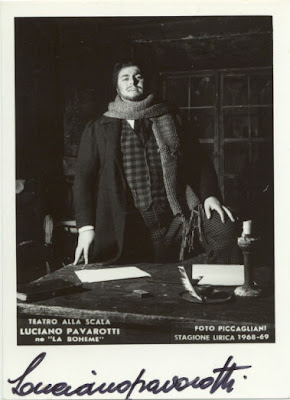
Big Luciano Passes Away


Luciano Pavarotti (October 12, 1935 – September 6, 2007)


Pavarotti in 'La Boheme' 1968Luciano Pavarotti, world-famous Operatic Tenor, died in his hometown of Modena in north-central Italy. He was 71, and had been battling pancreatic cancer.

Pavarotti died in the early morning of September 6, 2007 at home surrounded by his wife and four daughters. In an email statement, his manager wrote, "The Maestro fought a long, tough battle against the pancreatic cancer which eventually took his life. In fitting with the approach that characterized his life and work, he remained positive until finally succumbing to the last stages of his illness." In a text message to Reuters, Pavarotti's manager Terri Robson confirmed: "Luciano Pavarotti died one hour ago".

The rotund, black-bearded singer known as "Big Luciano" helped bring opera to the masses and performed to vast stadium audiences round the world.

Pavarotti was diagnosed with pancreatic cancer in July last year, forcing him to abandon a 40-concert farewell tour to undergo radiotherapy. He was sent to hospital for several weeks with a fever last month. His health deteriorated quickly after being released on August 25.

The Maestro"He remained optimistic and confident that he would overcome the disease and had been determined to return to the stage to complete his Worldwide Farewell Tour," Pavarotti's manager Terri Robson said in a statement.

For more information you can see the Maestro's official website www.lucianopavarotti.com

Here's a duet with the late Barry White. See? It ain't all about the opera.


From Wiki: Pavarotti annually hosted the "Pavarotti and Friends" charity concerts in his home town of Modena in Italy, joining with singers from all parts of the music industry to raise money for several worthy UN causes. Concerts were held for War Child, and victims of war and civil unrest in Bosnia, Guatemala, Kosovo and Iraq. After the war in Bosnia, he financed and established the Pavarotti Music Center in the southern city of Mostar to offer Bosnia's artists the opportunity to develop their skills. For these contributions, the city of Sarajevo named him an honorary citizen in 2006.

He performed at benefit concerts to raise money for victims of tragedies such as an earthquake in December 1988 that killed 25,000 people in northern Armenia.

He was a close friend of Diana, Princess of Wales. They raised money for the elimination of land mines worldwide. He was invited to sing at her funeral service, but declined, as he felt he could not sing well "with his grief in his throat".

In 1998, he was appointed the United Nation's Messenger of Peace, using his fame to raise awareness of UN issues, including the Millennium Development Goals, HIV/AIDS, child rights, urban slums and poverty.

In 2001, Pavarotti received the Nansen Medal from the UN High Commission for Refugees for his efforts raising money on behalf of refugees worldwide. Through benefit concerts and volunteer work, he has raised more than US$1.5 million, more than any other individual.

Other awards he received for charity work include the Freedom of London Award and The Red Cross Award for Services to Humanity, for his work in raising money for that organization, and the 1998 MusiCares Person Of The Year, given to humanitarian heroes by the National Academy of Recording Arts and Sciences.

Wednesday, September 05, 2007

Pino


PinoFunny how you can find things on the Web when you aren't looking for them. A case in point is the artist known as "Pino". His name is Pino Dangelico, and he comes originally from Bari, Italy. Beginning his commercial career as the painter of book covers, he was able to move beyond that very lucrative profession to simply painting, as he wished. I really enjoy the art of Pino, and I think you might, too.

If you remember my post on Harry Anderson, you may recall that his style is called "Loose Realism". Harry Steine, in discussing the work of Harry Anderson, described the technique of Loose Realism, thus: Maternal Instincts
Harry paid close attention to the fundamental aspects of visual storytelling. Focused points of interest were rendered with more informational detail, crisp edges for definition, and sharp contrast of value and hue, lightest lights against the darkest darks, for example. And although the element of detail (as in an object that has been rendered exactly as it appears in life), seems realistically portrayed in Harry’s paintings, it is a looser more impressionistic representation. This is created with, among other things, very deft and confident brush strokes or, as Harry called it “painting dexterity.” It reads like detail, but is in fact not.


InnocenceWell, Pino pains in the style of Loose Realism, and it's a very nice technique, with wonderful results. Pino Giclee.com has this to say about Pino:
Born on the cusp of a defining world war in Europe [November, 1939], Pino Dangelico's childhood visual memories are those of women left behind to keep the home fires burning. His mother, aunts, grandmothers and cousins became a universe of attractive Italian women in aprons, maintaining domestic tranquility in very uncertain times. Bathed in the Adriatic light of his native Bari, these figures would later infuse the romantic canvases of Pino that speak so softly to the hearts of Europeans and Americans alike today.

Afternoon StrollGrowing up with the faded glories of Renaissance art and architecture at his doorstep Pino was in tune with the energies of a new era and, despite his phenomenal success as one of the leading European illustrators of all time, he wanted to be closer to the dynamic art center of the world, New York. He also wanted to release his art from the restrictions of others and be free to explore new avenues that had been opened by the abstract expressionists of the late 1940's and early 1950's. A visit to Manhattan in 1971 exposed Pino to the exciting synergy of the United States and the museums of New York opened his eyes to the rich history of figure painting in America. In 1978 he returned with his wife Chiara, seven-year- old daughter, Paola and five-year-old son, Massimo. Unable to escape his commercial success in Europe, Pino soon became the highest paid American illustrator with over 3,000 book covers, movie posters and magazine illustrations to his credit. More importantly, his unique style not only dominated the market; it also exerted a profound influence on other artists' work from 1980 to 1995.

Late ReadingEager to leave illustration behind and to begin stretching the envelope of fine art with his fresh figural concepts and brilliant brushwork, Pino began showing his canvases to galleries. In 1992 he contacted one of the major galleries in Scottsdale, Arizona, The May Gallery, and sent five paintings which were well received. Since then his paintings have appeared in Morris & Whiteside Gallery in Hilton Head Island, South Carolina and Stuart Johnson's Settler's West Gallery in Tucson, Arizona. Pino has been invited to make several appearances on major TV networks and has been interviewed in national and international journals. With the immediate success among collectors, Pino began to distill over forty years of training and experience into each new painting. Combining all that he has learned from formal training and assimilated from observing the great masters, Pino has evolved a mature style that is both distinctive and deeply rooted in art history.


Now, maybe this isn't "high" art. Perhaps it is too accessible, too easy to understand and enjoy. Unlike the spatterings of Jackson Pollack, or the bizarre renderings of the celebrated Pablo Picasso, the works of such artists as Pino, or Harry Anderson, or Maxfield Parrish, among others, do what Art is supposed to do, as opposed to what the Art "Experts" and "Critics" want you to think Artists should do. It presents beauty, a story, a vision of something they see, for you to appreciate. No need, when looking at a Pino work, to ask, "What is it?" or check the label on the frame.

Whispering HeartBy the way, while wandering the Web, hunting for Pino prints, among others, to use here, I kept running into the word Giclée. I finally grasped that it's a technique for making prints. So I figured, why not search the word and make sure. From Wikipedia:
Giclée, commonly pronounced "zhee-clay," is an invented name for the process of making fine art prints from a digital source using ink-jet printing. The word “giclée”, from the French language word "gicleur" meaning "nozzle", was created by Jack Duganne, a print maker working in the field, to represent any inkjet based digital print used as fine art. The intent of that name was to distinguish commonly known industrial "Iris proofs" from the type of fine art prints artists were producing on those same types of printers. The name was originally applied to fine art prints created on Iris printers in a process invented in the early 1990s but has since come to mean any high quality ink-jet print.


And now you know!

Thursday, August 23, 2007

Good For What Ails Ya


Here's Johnny Cash performing a Kris Kristofferson song. From 1986, it's "Here Comes That Rainbow Again". Made me feel good, how 'bout you?


"Here Comes That Rainbow Again"

~ by Kris Kristofferson

The scene was a small roadside cafe,
The waitress was sweeping the floor.
Two truck drivers drinking their coffee.
And two Okie kids by the door.
"How much are them candies?" they asked her.
"How much have you got?" she replied.
"We've only a penny between us."
"Them's two for a penny," she lied.

And the daylight grew heavy with thunder,
With the smell of the rain on the wind.
Ain't it just like a human.
Here comes that rainbow again.

One truck driver called to the waitress,
After the kids went outside.
"Them candies ain't two for a penny."
"So what's it to you?" she replied.
In silence they finished their coffee,
And got up and nodded goodbye.
She called: "Hey, you left too much money!"
"So what's it to you?" they replied.

And the daylight was heavy with thunder,
With the smell of the rain on the wind.
Ain't it just like a human.
Here comes that rainbow again.

Sunday, August 19, 2007

I Remember The Music Of My Youth ...


I used to have an LP by Chet Atkins. My father got it as part of one of those record club agreements. It was titled, "Chet Atkins Picks On The Beatles". I don't know if Dad liked it or not, though I expect he sort of did. Dad, though decrying Rock 'N Roll, seemed to find most music enjoyable. After all, he and Mom bought me my first Johnny Cash album, introduced me to my love of Classical music, and reared me on a steady diet of Big Band recordings, Frank Sinatra, and Dean Martin.

I think Dad tried to be the arch-conservative, and yet enjoyed so many things in the world of music. Anyway, when I discovered this album I was already a Beatles fan, though it was a kind of secret thing - we don't discuss Rock music around here! Shhh! - and I discovered that Chet Atkins intuitively felt the beauty of early Beatles songs and played better "cover" versions than so many other recording artists of the day. But I never followed Chet Atkins or his career, and the only lingering taste I had was that old, hissing album, now long lost.

Here's one of the world's finest guitar pickers, some years later, on his own television show, playing a medley of Beatles tunes, only one of which he'd played on that old album.

Can you figure out what the songs are?

PS: I now have the CD of that old album! It's still fantastic!


The Beatles songs Chet played were "If I Fell", "For No One", "Something", and "Lady Madonna".

The only cover version of a Beatles tune that I really enoyed was this version by the Mamas And Papas. It's the second cut in this medley.


Thursday, August 16, 2007

August 16, 1962


Ringo Pre-Mop Top
"Ringo's a damn good drummer. He was always a good drummer. He's not technically good, but I think Ringo's drumming is underrated the same way Paul's base-playing is underrated. Paul and Ringo stand up anywhere with any of the rock musicians." John Lennon ~ from a Playboy magazine interview (1980)


Ringo Star: HurricaneForty-five years ago one of the most important moments in the history of Rock 'N Roll music took place. A Liverpool, England band, fresh from signing their first recording contract, decided to fire their drummer and replace him with the drummer from one of the rival bands in the area. Pete Best, drummer from 1960, was sacked, and Richard Starkey, the popular drummer from Rory Storm and the Hurricanes, was hired to replace him. We know Mr. Starkey as Ringo Starr. The band? The Beatles.

Ringo the Mop Top
"First and foremost I am a drummer. After that, I'm other things. ...But I didn't play drums to make money. I played drums because I loved them. ...My soul is that of a drummer....It came to where I had to make a decision -- I was going to be a drummer. Everything else goes now. I play drums. It was a conscious moment in my life when I said the rest of things were getting in the way. I didn't do it to be come rich and famous, I did it because it was the love of my life." Ringo Starr ~ quoted in The Big Beat by Max Weinberg(1984)

Less than a year before Ringo had played with the Beatles at the Cavern Club, replacing an ailing Pete Best. He already knew the Beatles well, having played on some of the same bills in Hamburg, Germany, while a member of the Hurricanes. But the Hurricanes were going nowhere, having pretty much reached the peak of their popularity and creativity. So Ringo was looking for something better.

Pete Best, though, had something of a rabid following among Beatles fans. A rather vocal following. Playing their first show at the Cavern Club following the firing of Pete Best, his fans in the audience took up chanting, "Pete Best Forever, Ringo Never!" And they weren't only vocal. Lead guitarist George Harrison received a black eye that night from an angry Pete Best fan.

Pete Best still thinks he got a raw deal and Ringo Starr merely stepped into a sweet deal. As a drummer ... I think Mr. Best was a good baker's assistant.

Although several odd theories have surfaced over the years about the "real" reason for Best's ouster (Paul was jealous of Best's James Dean looks, John and Paul thought he was too popular, and so on), some seem to make the most sense and are accepted by Beatles fans as official. The Beatles' famous mop-top hair style was created in Hamburg, Germany, and was a bit of a hit. But Best refused to cut his hair that way. He continued to wear his hair in a pompadour and DA. Poorest styling decision in recording history, I think.

Also, the producer assigned to the Beatles, by EMI - George Martin - didn't think Pete Best was much of a drummer. In fact, as he has said often, and the Beatles themselves repeated, Martin told manager Brian Epstein that they could keep Best for public appearances, but he would not play on any recordings. Yes, Best was that bad. A pedestrian drummer at "best"!
George Martin with Paul and Ringo
"Ringo always got and still gets a unique sound out of his drums, as sound as distinctive as his voice. ... Ringo gets a looser deeper sound out of his drums that is unique. ...This detailed attention to the tone of his drums is one of the reasons for Ringo's brilliance. Another is that although Ringo does not keep time with a metronome accuracy, he has unrivaled feel for a song. If his timing fluctuates, it invariably does so in the right place at the right time, keep the right atmosphere going on the track and give it a rock solid foundation. This held true for every single Beatles number Richie played ... Ringo also was a great tom tom player." ~ George Martin, 1994

Ringo Starr became the "nice" Beatle, the "fun" Beatle, the least dangerous Beatle. He also became a drumming icon for many young rockers. He was self-taught at the drums, so never learned the traditional way of holding drum sticks. He held them the same in both hands, which he found added drive to the rock beat. He wasn't the first, probably, to do that, but he was the first real Rock 'N Roll drummer. Everybody else followed him. Rather than play the upbeat as so many drummers did at the time, Ringo played the downbeat - a back beat - that was easier for the others to hear and follow. Some critics complained that he didn't keep metronomic time, but he started and finished where he was supposed to,a nd was inventive in his play while never trying to overshadow his band-mates. The ego the other Beatles had in spades, Ringo never really had.
During the 'Let It Be' sessions
"I consider him one of the greatest innovators of rock drumming and believe that he has been one of the greatest influences on rock drumming today... Ringo has influenced drummers more than they will ever realize or admit. Ringo laid down the fundamental rock beat that drummers are playing today and they probably don't even realize it. (Modern Drummer,Oct. 1987) . . Ringo always approached the song more like a songwriter than a drummer. He always served the music." (Modern Drummer, Dec. 1987) ~ Kenny Arnoff


According to Phil Collins, Ringo is "vastly underrated. The drum fills on "A Day In The Life" are very complex things. You could take a great drummer today and say, 'I want it like that.' They wouldn't know what to do."

Spending most of his childhood moving in and out of hospitals, where he learned to play the drums, Starr's health slowly improved, and as a teenager he played the English holiday camps known as Butlins. Here, he developed the eclectic skills and diverse musical knowledge that would serve him well in years to come. Playing in various "beat" groups of late-'50s Liverpool, Starkey, using the show name Ringo Starr (due to his penchant for gaudy rings) became a local favorite with the band, Rory Storm & the Hurricanes.

Mr. Starr - still going strong“Ultimately what’s most impressive about Ringo Starr isn’t what he’s been, but rather who he is,” wrote Rolling Stone rock critic David Wild. “The man’s great heart and soul, his wit and wisdom.”
"When we first started, they basically went John and Paul's way because they were the writers and they would say, "This is the song," and I would play as creatively as I could. Sometimes I would have three people telling me how to do it. They were saying playing this like on that track. I'm saying, "For Christ's sake, there are two drummers there." They could never hear that, you know. You'd have to have four arms to do half the stuff they wanted me to do." Ringo Starr ~ from an interview in Viva magazine (1978)

The Real Beatles Drummer
American Beatles?

Sunday, July 22, 2007

The Weekend Continues


I remember reading a story many years ago, that may have been apocryphal, yet remained with me all these years. It seems that during World War Two, while the Soviets were trying to defeat tiny Finland, and bring it back into the Russian fold - it had been a Grand Duchy in Czarist times, gaining its Independence in 1917 - (this is the 'Winter War', which the Soviets essentially lost, by the way!), an aged, semi-retired composer by the name of Jean Sibelius, would trudge out of his house, into the snow, taking his hunting rifle with him, and fire at the Soviet planes as they flew overhead. He was in his late 70s by then. And that struck me!

What a spunky old man!

Sibelius is best known outside Finland for a few works, among them Valse Triste, the Karelia Suite, and The Swan of Tuonela. But he is best remembered for "Finlandia", a nationalistic piece that was composed in 1899, then rewritten shortly thereafter as the final movement became something of a Nationalist Anthem for the Finns. I have a nice version of it below, from YouTube, with images and video of Finland.


conductor:Paavo Berglund

orchestra:the Philharmonia Orchestra


Wikipedia:
The piece was composed for a patriotic pageant performed to mobilise popular opposition to the revocation of Finnish independence from the government of the Russian Empire.

Most of the piece is taken up with rousing and turbulent music, evoking the national struggle of the Finnish people. But towards the end, a calm comes over the orchestra, and the serenely melodic Finlandia Hymn is heard. Often incorrectly cited as a traditional folk melody, the Hymn section is of Sibelius' own creation.

Sibelius later reworked the Finlandia Hymn into a stand-alone piece. This hymn, with words written in 1941 by Veikko Antero Koskenniemi, is one of the most important national songs of Finland.


Incidentally, the 1990 film Die Hard 2 ends with Finlandia (the director, Renny Harlin is Finnish). Fans of the Die Hard films will probably recognize the music.

This is one of my Classical favorites! I hope you enjoy it, too. And enjoy the scenery during this hot summer.

And just to make sure you enjoy some nice music, here's Edvard Grieg's "Morning Mood" from the Peer Gynt Suite. I know you'll recognize it. As Wikipedia says:
"Morning Mood" (Norwegian: Morgenstemning) is a composition belonging to Edvard Grieg's Peer Gynt suite. Used often in television commercials and motion pictures, the piece depicts the rising of the sun. Next to In the Hall of the Mountain King, Morning Mood is Grieg's most known work.

Contrary to popular belief, it was not meant to depict a sunrise over the Norwegian fjords. It was actually meant to depict a sunrise over the Sahara Desert.


Edvard Hagerup Grieg was born in Bergen, Norway, on 15 June 1843. His ancestors were Scottish; the original family name was spelled "Greig". After the Battle of Culloden in 1746, his great-grandfather travelled widely, settling in Norway around 1770, and establishing business interests in Bergen. Grieg was raised in a musical home. His mother, Gesine, became his first piano teacher.

Friday, July 20, 2007

Nice Music: The Weekend Is Here, So Enjoy


A long time ago, at the birth of the British Invasion, a small group in Birmingham, England attempted to create some kind of R&B/Rock 'N Roll fusion and failed. They managed a single hit song, "Go Now", and pretty well disbanded. They called themselves the Moody Blues. Over time new members were added and they revamped their sound completely. The three remainng original members, Ray Thomas, John Lodge, and Michael Pinder recruited others, among them, Justin Hayward and Grame Edge. Those five musicians became the group that gained fame. In 1967 they produced the album, "Days Of Future Passed" which was an enormous hit, both in merry Olde England, but around the world as well. Two of the songs on that album are among the most easily recognizable Rock hits in history, namely, "Nights In White Satin" and "Tuesday Afternoon".

Here's a live recording of the Moody Blues playing "Tuesday Afternoon" for a small crowd. For me it's a very lovely song, one I could never quite sing - not enough breath to hold Justin's long notes - but which I still enjoy. Recognize it?


The first Moody Blues album I heard, and bought, was "On The Threshold Of A Dream". My friend, Jimmy Oswald, played it at his house one afternoon, and I was hooked. And the songs on it are the ones I like most of all by the Moody Blues. Maybe because it was the first MB album I owned? Dunno, but it's how I feel.

One of the songs on that album is called, "Never Comes The Day". I like how it moves from ballad to rock and roll and back. It's pretty. And it's here for you, as well! LOL


It seemed forever from "Seventh Sojourn" to "Octave". In fact, by the time "Octave" was released I had thought the Moody Blues had disbanded. And in fact in 1973 they announced that they were disbanding, after "Seventh Sojourn" went to Number 1 in 1972. Only Justin Hayward wanted to continue. They all went their own ways and worked solo.

In 1977, with Mike Pinder now living in California and raising a family, they got together there to begin work on an album. They produced "Octave" which I eagerly snapped up. Although it wasn't their best work, it has its moments and some nice songs. One of the prettiest is "Driftwood". This is a studio production of the song. The keyboardist is no longer Mike Pinder who didn't want to tour any longer. Patrick Moraz, who had been asked to leave the band Yes, was hired to take Pinder's place. But it is Pinder's work you hear on this version. Moraz would be asked to leave the Moody Blues later on, after they heard him bad-mouthing them in an article in Keyboard magazine. Nice career, eh? Anyway, here's "Driftwood". Enjoy.


Thursday, July 05, 2007

A Deft Touch


I trust you are enjoying the Fourth of July! Stay safe!

I've taken to surfing through the YouTube files doing searches for my favorite performers, looking for old songs I can remember, and some I can’t. Naturally I’ve played a lot of the Beatles’s videos there, grabbing a bit of nostalgia with the performances. And at times I do a search for the individual Beatle, curious to see what’s there.

Here’s a song from twenty years ago, one that I’d fairly well forgotten, though it was a bit of a hit in 1987. It’s a George Harrison tune, from the Cloud 9 album – remember albums? – and highlights George’s deft touch at light songs. Given his slight voice, when compared to his bandmates, it’s refreshing to hear him sing this. It’s also a pretty song with all the trademark Harrison slide guitar touches.

We’ve always rather forgotten George Harrison, over-shadowed as he’s been by such talents as Paul McCartney and John Lennon, not to mention the popularity of Ringo Starr. But George could display a deft touch with a song, especially with a love song, or a mood song. This is one of his mood songs, I think, but the melody is easy to remember, something not every song reaches. And it’s nice, also something not every song attains.

It’s called “This Is Love”


This Is Love
~ by George Harrison


Precious words drift away from their meanings
and the sun melts the chill from our lives
helping us all to remember what we came here for
this is love
this is la la la la love
this is love
this is la la la la love

Little things that will change you forever
may appear from way out of the blue
Making fools of everybody who don't understand
This is love
this is la la la la love
this is love
this is la la la la love

This is love, this is love
this is love, this is la la la la love

Since our problems have been our own creation
they also can be overcome
When we use the power provided free to everyone
this is love
this is la la la la love
this is love
this is la la la la love

This is love
this is la la la la love
this is love
this is la la la la love

Monday, June 25, 2007

Autumn Leaves


As the YouTube entry says, "Beautiful photo slideshow of fall colors with the voice of Frank Sinatra and piano artistry of Richard Clayderman." This always brings to mind lost loves. In my own case my lost Sweet Patootie.


This evokes the same things I suppose.


Wednesday, June 13, 2007

Overkill


It's funny how a song will strike you. Some intrude and scurry away, scarcely bothering you and leaving little behind to show their passing. Others will run through your head and force you hum along, or try to catch the lyrics. Nowadays, with the Internet such a handy tool for finding all sorts of things, finding lyrics is a snap. And if you know the singer's name, or the title of the song, why you are practically there.

I watch some reruns before I head to bed, among them "Scrubs" which I find quite funny. The local station used to play a pair of episodes back-to-back. But recently they decided to split the episodes so that the second one airs at midnight. Lousy, stinkin' .... grrrr!

Anyway, one of the episodes had a guest star, namely Colin Hay, formerly of Men At Work, the Australian Rock Band of the early 80s. He plays a sort of intinerant Troubador, singing a song that intertwines with the show's stars and their troubles of the day. The song, which is played throughout the episode, in small vignettes, went right to my heart. Seriously! I heard it and began looking forward to the chorus, and then back to the verses, and so on. Naturally I went surfing. I found some good stuff!

The episode was a funny one, and Colin Hay's performance simply enhanced it perfectly. Below are two clips from YouTube - yeah YouTube is a Leftist company, but whattya gonna do? - the first a cleverly edited version of the performance in Scrubs. I know you'll recognize the face of Colin Hay, if you were following Rock in the 80s. The second clip is a live performance of the same song, "Overkill". The acoustic version sets a rather nice mood.


Overkill
by Colin Hay (Men At Work)


I can't get to sleep
I think about the implications
Of diving in too deep
And possibly the complications

Especially at night
I worry over situations
I know I'll be alright
Perhaps it's just imagination

Day after day it reappears
Night after night my heartbeat shows the fear
Ghosts appear and fade away

Alone between the sheets
Only brings exasperation
It's time to walk the streets
Smell the desperation

At least there's pretty lights
And though there's little variation
It nullifies the night from overkill

Day after day it reappears
Night after night my heartbeat shows the fear
Ghosts appear and fade away
Come back another day

I can't get to sleep
I think about the implications
Of diving in too deep
And possibly the complications

Especially at night
I worry over situations
I know I'll be alright
It's just overkill

Day after day it reappears
Night after night my heartbeat shows the fear
Ghosts appear and fade away


Your opinion?